

A small, easy-to-access wardrobe can bring a sense of calm and a good mood to its owner. But in reality, it’s not always easy to organize clothes. We use our clothes every day, often several times a day, so things can quickly become messy. To make clothing easier to manage, Marie Kondo includes clothes as the first category to declutter in the KonMari Method. The goal is not just cleaning or organizing, it’s about choosing to surround yourself with items that "spark joy."
Here’s how to apply the KonMari Method to your clothes step by step.
- 1. Start With Decluttering, Not Organizing
- 2. A Simple Checklist of Clothing Categories
- 3. Start With the Obvious “No”
- 4. Then Ask: Does It Spark Joy?
- 5. Store Clothes After Decluttering
- How Long Does KonMari Clothes Usually Take?
- Why the KonMari Method Works So Well to Organize Clothes
- Remember: There Is No Perfect System
1. Start With Decluttering, Not Organizing
One of the biggest mistakes people make is trying to organize before decluttering. Buying fancy storage boxes or rearranging drawers make things look tidy for a moment, but it doesn’t solve the real problem. If you try to organize without decluttering, you are just moving the problem around. The KonMari Method always starts with decluttering first.
Another important difference is that the KonMari Method works by category, not by room. Instead of cleaning one closet at a time, you gather all clothes from everywhere in your home.
This includes items from:
- Closets and drawers
- Laundry baskets (make sure your laundry is done first!)
- Off-season storage boxes in the attic or under the bed

Place all your clothes in one spot, such as on your bed or the floor. When you see the full volume of what you own, you may be surprised by how many clothes you actually have. This visual moment helps you become more aware and make more intentional decisions about what to keep.
2. A Simple Checklist of Clothing Categories
Use the checklist below to make sure you gather every clothing item before you start deciding what to keep.
Tops
- T-shirts
- Shirts
- Sweaters
- Jackets
Bottoms
- Jeans
- Pants
- Shorts
- Skirts
Items Usually Hung
- Long dresses or maxi dresses
- Formal wear or suits
- Delicate fabrics that wrinkle easily
Small Clothing Items
- Socks
- Underwear
- Bras
Accessories
- Hats
- Scarves
- Belts
- Jewelry
Bags
- Handbags
- Laptop bags
- Backpacks
Shoes
Special Clothing
- Swimwear
- Uniforms
- Event or party clothes
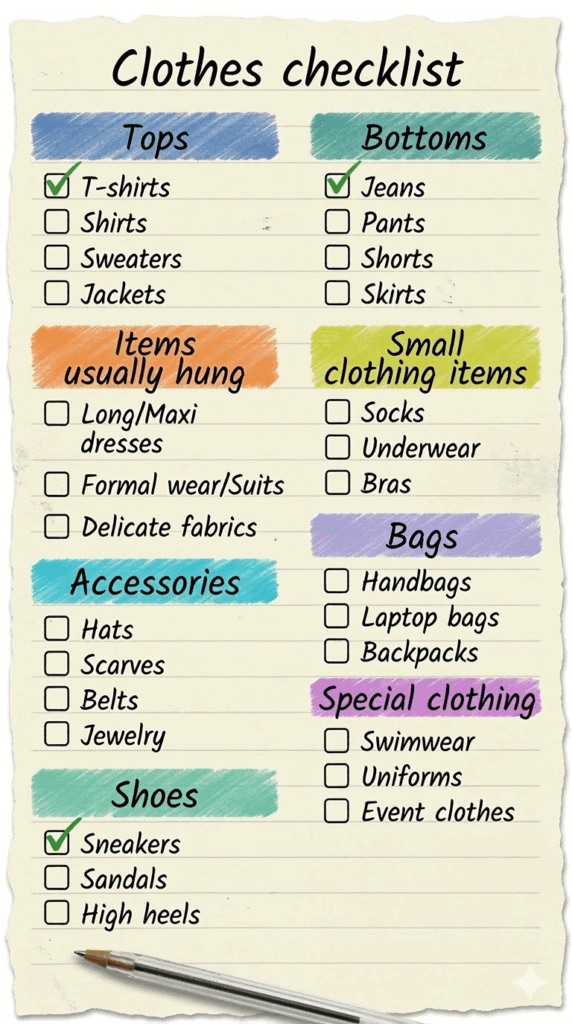
Once everything is gathered together, you’re ready to start making decisions.
3. Start With the Obvious “No”
Before asking whether something sparks joy, begin by removing items that are clearly no longer useful.
When you look through the pile, you will quickly notice pieces that are easy to decide. These often include:
- Clothes that no longer fit
- Damaged items
- Pieces you haven’t worn for years

These items usually don’t require much thought. If you already know you won’t wear them again, simply set them aside for donation or disposal.
This quick first pass makes the rest of the process much easier. By removing the obvious “no” items first, you reduce the number of clothes you need to evaluate more carefully.
4. Then Ask: Does It Spark Joy?
After removing the obvious discards, the remaining clothes deserve a closer look.
This is where the famous KonMari question comes in: “Does this spark joy?”
Pick up each item and hold it in your hands. Notice your reaction. Some clothes immediately make you feel good. You might think:
- “I love wearing this.”
- “This always makes me feel confident.”
- “This is one of my favorite pieces.”
Those are easy decisions, keep them.
Some clothes may feel neutral or leave you uncertain. You might have bought them because they were on sale, or because you thought you might wear them someday. If an item doesn’t bring a positive feeling or support your current lifestyle, it may have already fulfilled its purpose. You can choose to keep it, let it go, or place it in a “maybe” box if you’re unsure, but remember to review that box within a week.
The goal isn’t to hold on to everything you might wear someday. The goal is to keep the clothes that truly support your life today.
5. Store Clothes After Decluttering
Once you have reduced your wardrobe, storing clothes becomes much easier. The KonMari Method focuses on simple systems that make everything visible and easy to access.
The main idea behind this is simple: clothes should be folded into compact shapes that can stand upright. This allows you to see every item at a glance, instead of stacking clothes in piles where the bottom pieces get forgotten.
If you're unsure how the folding works, you can watch the video below for a simple demonstration:
However, there is no single perfect way to fold clothes. The best system is simply the one that works for your wardrobe and your space.
How I Adapted KonMari Folding in My Wardrobe
My wardrobe doesn’t fully support vertical folding, but stacking clothes always made it hard to find items at the bottom. So I prioritize vertical folding for items that can stand easily, these include:
- sweaters
- jeans
- T-shirts
Inside my drawers, I use small square baskets to keep things organized. They separate:
- skirts
- shirts
- shorts
- long pants
For pajama sets or matching outfits, I fold the top first and then wrap the pants around it so the whole set stays together.
For workout clothes, I use IKEA boxes because the fabrics are softer and harder to keep upright.
Clothes That Are Better Hung
Some items simply work better on hangers. For example:
- delicate fabrics
- formal wear
- long dresses
- clothes that wrinkle easily

Hanging these items helps them stay neat and ready to wear.
Underwear and Socks
Small items are easiest to manage with simple boxes. I roll underwear and store them in one box. Bras have their own box. Socks are paired together so they don’t get separated.

This makes it much easier to grab what you need without digging through a messy drawer.
Bags and Accessories
Bags, belts, and scarves are hung inside my wardrobe. My closet has two sections, so one side holds clothes while the other side stores accessories. This keeps everything visible and easy to reach.
Hats
Hats are stored in a drawer using two boxes. I stack them instead of folding them to avoid damaging their shape. The boxes are placed on a higher shelf where they stay protected but still accessible.
Shoes
Shoes are stored in the family shoe cabinet near the entrance of the home.
Once a week, I quickly review them to see which pairs I actually wear and which ones I might donate or remove.
Because I have a baby, I also check her shoes every month to see if they still fit. If they become too small, I pass them on or donate them.
Seasonal Clothes
Clothes that are out of season can be stored separately. For example, winter coats or heavy sweaters can be placed in storage boxes or on higher shelves when it’s summer.
The goal is simply to keep your current wardrobe easy to access.
How Long Does KonMari Clothes Usually Take?
Many people wonder if they need to finish everything in one day. In reality, it depends on how many clothes you own. For most people, decluttering clothes takes several hours or a full day.
The most important rule is to finish the entire clothing category before moving on to another category. Completing one category fully helps you build confidence and momentum for the rest of the decluttering process.
Why the KonMari Method Works So Well to Organize Clothes
The KonMari Method is especially effective for clothing because it changes how you relate to your wardrobe.
Some of the biggest benefits include:
- You clearly see everything you own.
When clothes are organized properly, nothing gets forgotten at the bottom of a pile. - Getting dressed becomes faster.
You spend less time searching for outfits and more time enjoying your day. - Your wardrobe becomes easier to maintain.
When everything has a place, keeping things tidy takes very little effort. - You become more intentional about buying clothes.
After decluttering, many people naturally stop buying items without clear purposes.
Remember: There Is No Perfect System
It’s important to remember that there is no single “correct” way to organize clothes. The best system is the one that fits:
- your wardrobe space
- your daily habits
- your lifestyle
The KonMari Method is not about creating a perfectly minimal wardrobe or following strict rules. Instead, it is about creating a wardrobe that supports your life, one that makes getting dressed easier, and more enjoyable.
And sometimes, that small daily improvement can make a bigger difference than we expect.


